

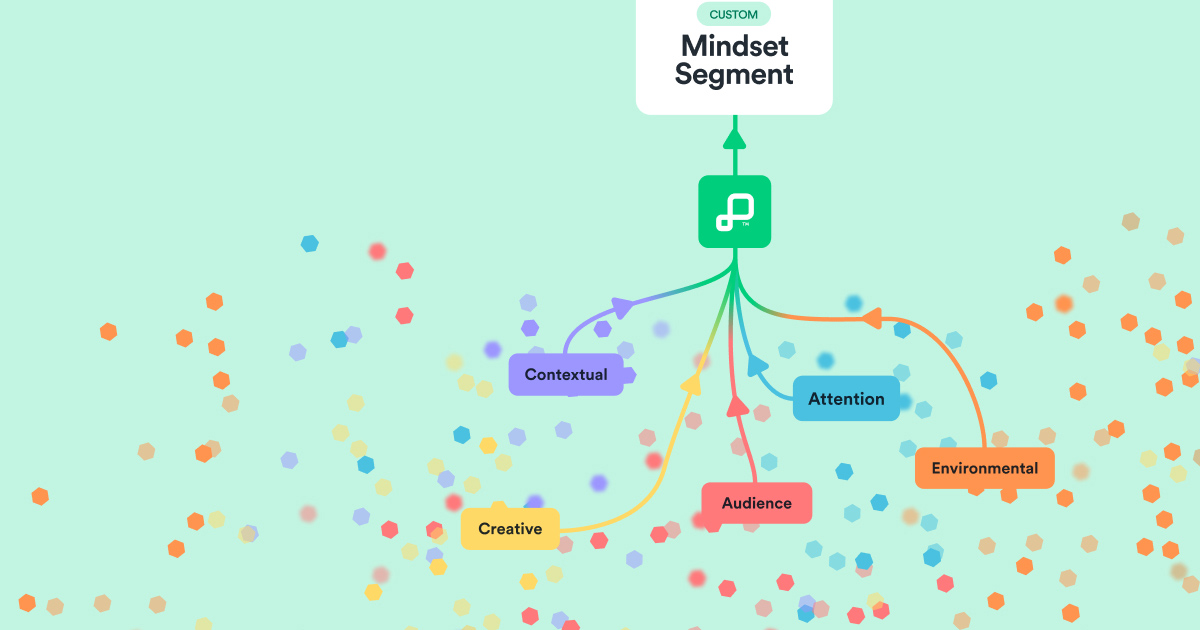


The Mindset Agent inside the Mindset Portal builds bespoke segments from your brief, giving you control to refine them and flexibility to activate them your way.
Has this ever happened to you?
You spend weeks building a campaign brief around a specific audience, message, objective, and strategy. Then it’s time to activate, and all that nuance gets squeezed into a broad category, a predefined segment, or the closest available targeting option.
Somewhere between the brief and the buy, your strategy gets smaller.
Custom Mindset Segments go beyond traditional contextual targeting by starting with the strategy in your campaign brief. Inside the Portal, GumGum’s Mindset Agent uses the Mindset Graph™ to interpret the brief’s audience, message, objectives, exclusions, and intent, creating a segment you can review, refine, and activate directly with GumGum or programmatically within your preferred DSP.
And now, those segments can go further. Advertisers can activate them directly with GumGum, through GumGum-managed PMPs across supported DSPs, or through other supported buying workflows, bringing custom Mindset Segments into more of the environments teams already use.
Your campaign strategy has long been flattened by the activation process. Time to give it its shape back.
Why Predefined Categories Flatten Campaign Strategy
Your campaign should stay yours.
No two campaign briefs are quite the same. Even when the audience looks similar on paper, the message, objective, creative idea, exclusions, and definition of success can differ completely.
That is where your bespoke Mindset Segments earn their keep.
Instead of starting with a predefined audience or content bucket and asking where the campaign fits, the segment is shaped around the campaign itself. The strategy in the brief becomes the starting point, not something that has to be translated down into the closest available option.
That matters because even the right category can still be too broad. A nail polish campaign, for example, might naturally map to Beauty. But Beauty can also include hair care, skincare, makeup, and plenty of other content that may have little to do with the campaign itself. At the same time, highly relevant nail polish moments might show up in fashion coverage, celebrity culture, holiday gifting, or conversations around self-expression.
The category is not wrong, but it can only carry so much of the strategy. A custom Mindset Segment starts with the campaign brief, using multi-dimensional vector-based modeling to identify the content that best aligns with its audience, message, objectives, and intent. That creates a segment tailored to the campaign, going beyond broad contextual categories to get closer to the moments that really fit.
Your campaign shouldn’t have to lose its specificity just to fit the buy.
Where Can You Activate Custom Mindset Segments?
Build the segment around the campaign. Activate it where the campaign needs to go.
Building a custom segment around the campaign is only half the equation. The other half is making sure buyers can use it where they already work.
Custom Mindset Segments are now available across more activation paths:
- Direct with GumGum: Apply the segment to supported GumGum-managed campaigns.
- Through GumGum-managed private marketplaces (PMPs): Package the segment into a managed PMP for activation across supported DSPs, including Amazon DSP, Display & Video 360 (DV360), Yahoo DSP, BidSwitch, DeepIntent, Viant, Basis, StackAdapt, PulsePoint, Beeswax, and Equativ.
- In The Trade Desk: Send the segment directly to your seat and activate it within your campaign.
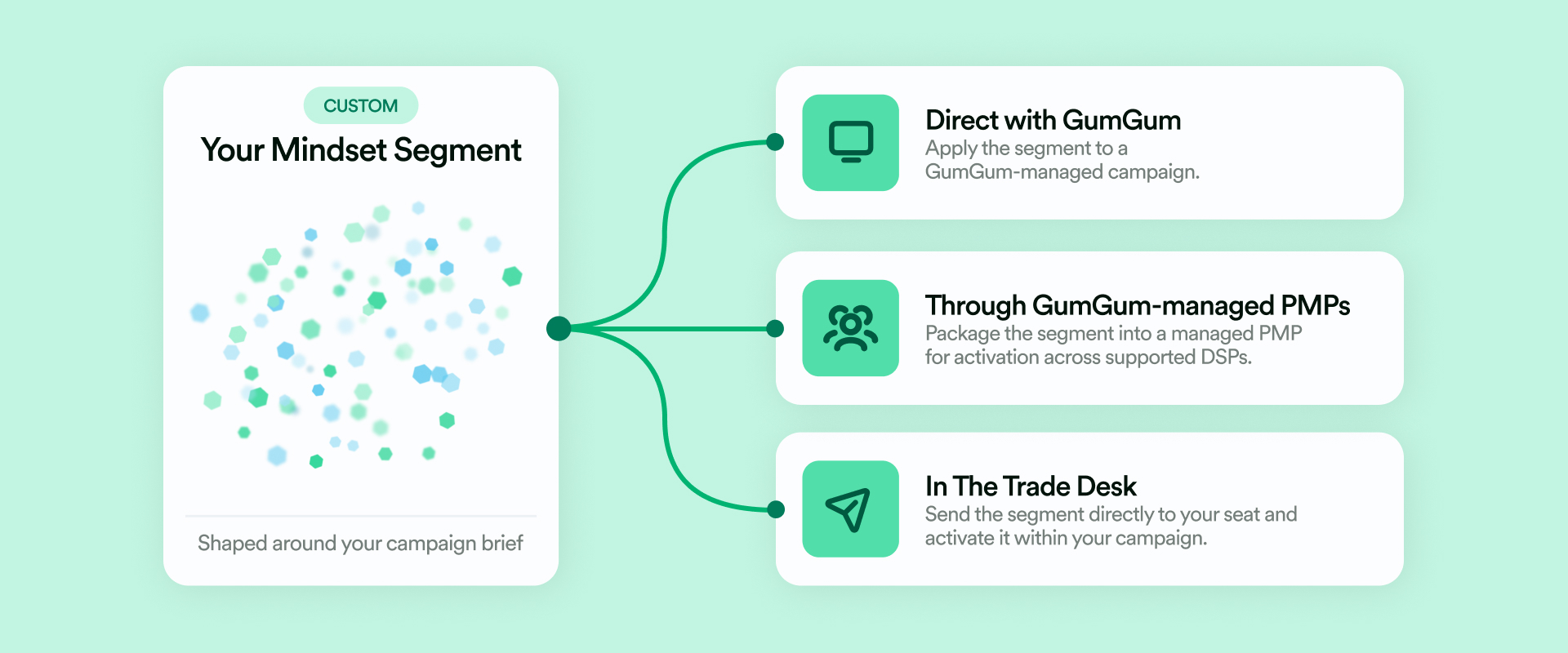
That gives buyers more choice without asking them to rebuild the segment for a different environment.
Read More: GumGum Expands Reach: High-Impact Ads Now Accessible Globally via Amazon DSP
And that portability matters because media buying is rarely just copy and paste. One campaign may run directly with GumGum. Another may need to live inside an agency’s existing DSP workflow. Another may require a different activation path entirely.
The segment can follow the buying strategy, rather than forcing the buying strategy to follow the segment.
That is really the promise here: more room to move without losing what made the segment specific to the campaign in the first place.
And an important distinction: Mindset Segments are one campaign-specific expression of GumGum’s broader mindset capabilities. The Mindset Graph™ already powers how GumGum understands relevance and activates against moments within its platform. What’s expanding now is where advertisers can take the personalized segments they create.
Build the segment around the campaign. Activate it where the campaign needs to go.
How the Mindset Agent Turns a Brief Into a Segment
Put the Power to Activate in Your Hands. This is where the idea becomes tangible.
Inside the Portal, the Mindset Agent gives you a direct way to take the strategy you’ve already built and shape it into a custom segment you can understand, challenge, and ultimately approve.
Powered by the Mindset Graph™, the Agent reads your brief and identifies the details that shape the campaign: the brand, audience, objectives, messaging, targeting preferences, exclusions, and KPI goals. It then uses the meaning and intent behind that strategy to recommend relevant content themes and build a segment specific to the campaign.
What Happens Under the Hood
The Agent does a lot of work behind the scenes to get from campaign strategy to segment:
- Campaign intent: Pulls the strategy from your brief, including audience, message, objectives, and exclusions.
- Semantic embeddings: Translates that intent into a representation of meaning, not just keywords.
- Vector similarity: Compares that meaning against pages and videos to find content aligned with the campaign.
- Every page scored: Evaluates each page against the brief for relevance.
- Dynamic thresholds: Sets the cutoff for what makes the segment based on the needs of the campaign.
But all that intelligence under the hood doesn’t mean handing over control. The Agent does the heavy lifting; you still get to see, question, and shape what comes out of it.
What Stays in Your Hands
Review the brief. See how the Agent interpreted the campaign, make edits, and add context before moving forward.
Refine the themes. Review the content themes generated from the strategy, keep what fits, and remove or adjust what does not.
Inspect the segment. Explore sample URL matches, see why the segment aligns with the brief, and get a clearer view of what is being targeted.
Prepare for activation. Once the segment looks right, choose the activation path that fits the buy.
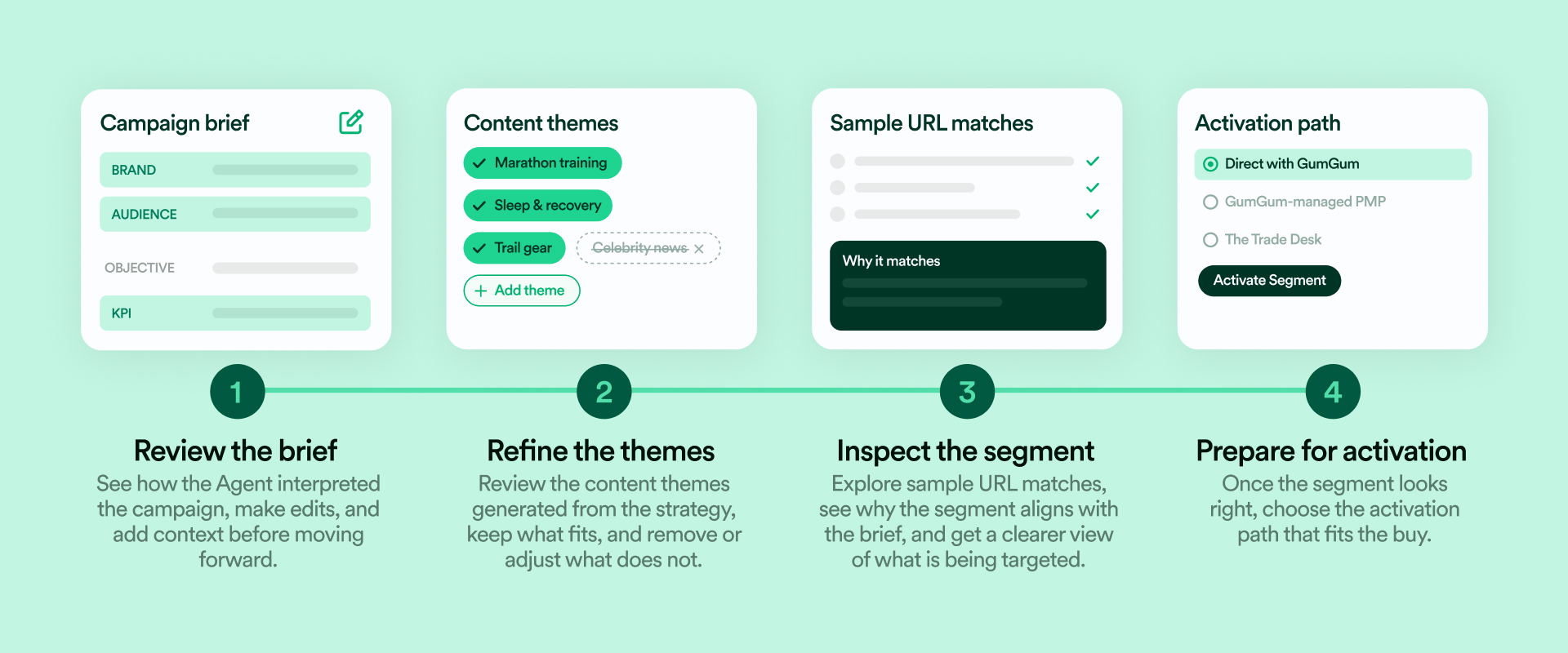
That visibility is a big part of the value. Instead of being handed a targeting segment and asked to trust the black box, you can see the thinking behind it and bring your own judgment to the process.
The AI does the heavy lifting at scale. You decide whether it got the brief right.
And when it does, the segment is ready to move into the activation path that works for you. The Portal is not replacing the DSP. It gives you a clearer path from the strategy you wrote to the segment you’re ready to buy.
The brief is yours. The segment is yours to shape. The activation path is yours to choose.
{{cta-1}}